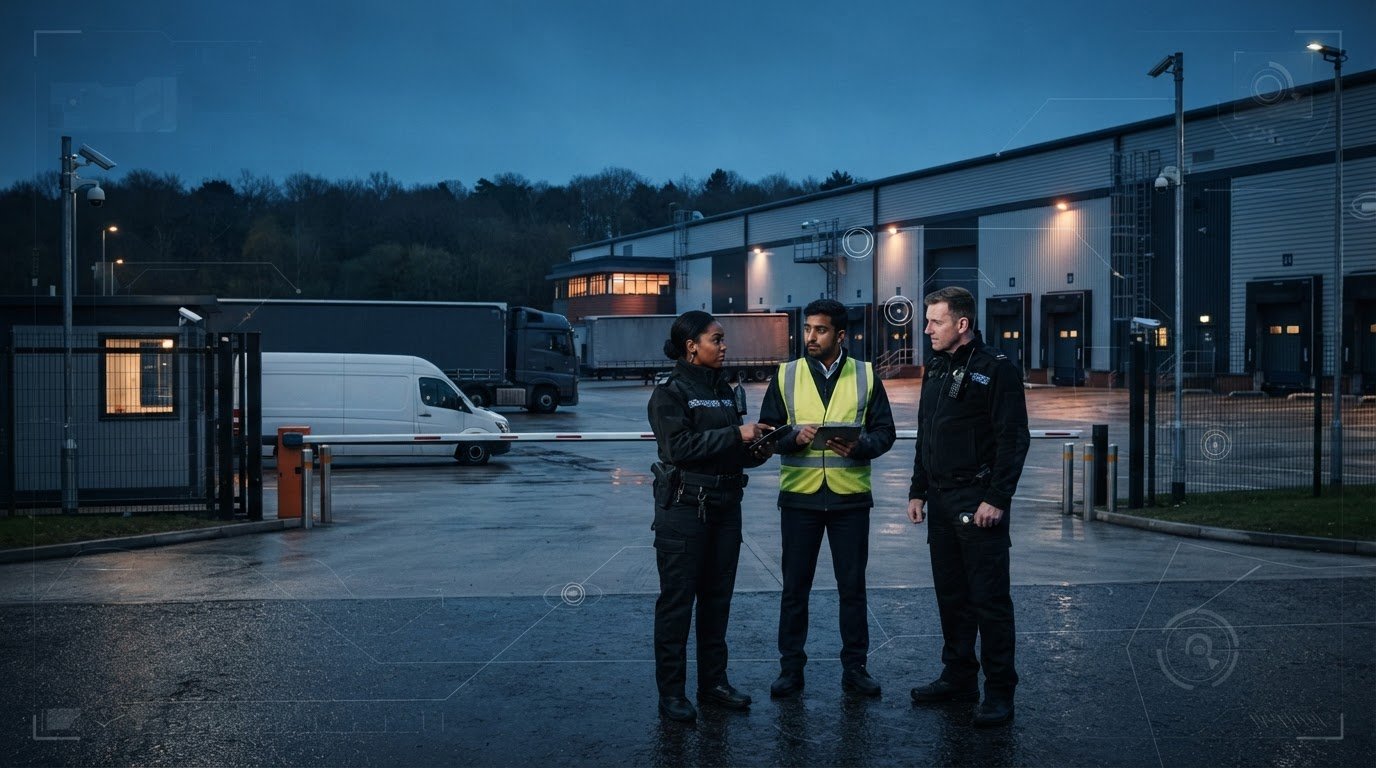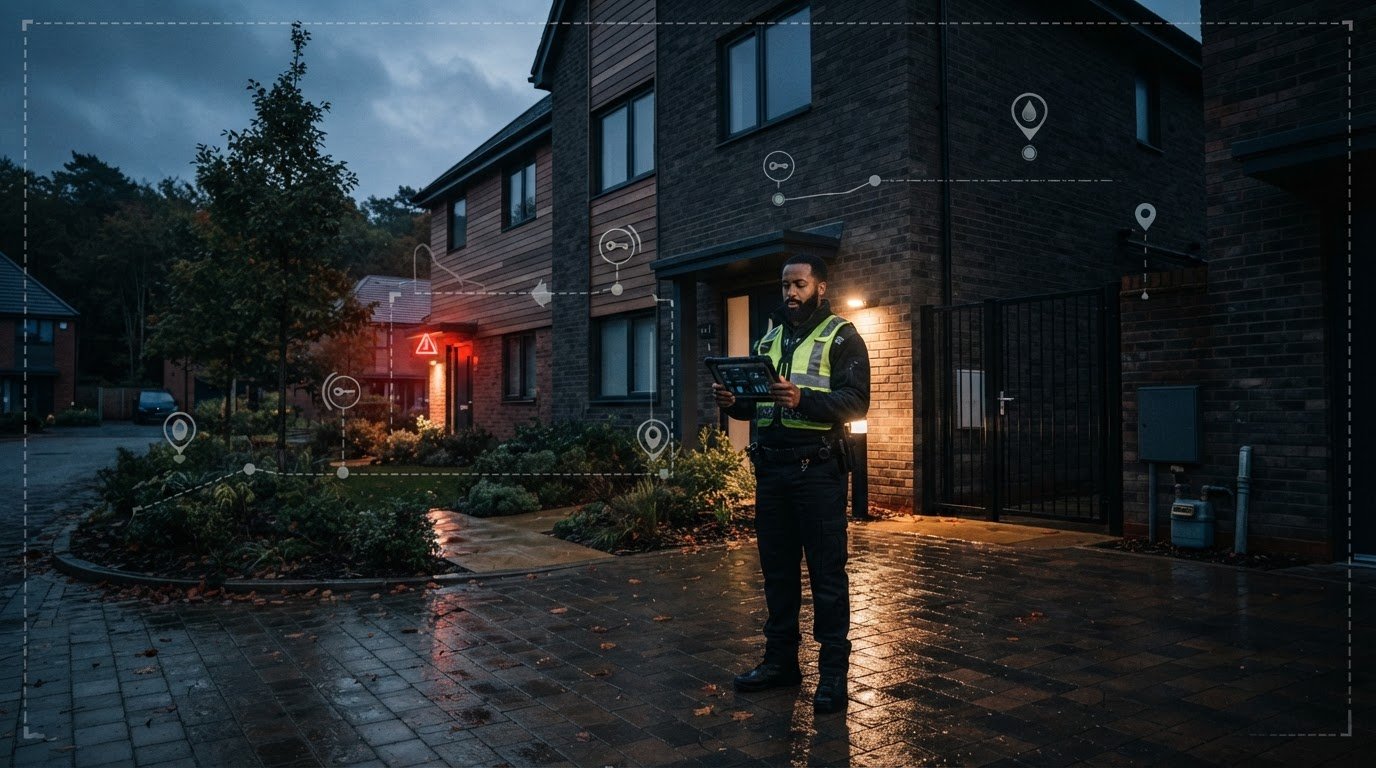

Security for Empty Properties in Berkshire: 2026 Guide
A locked door is not a security plan. For security for empty properties Berkshire owners need more than a final turn of the key: a vacant building can change as its use, condition and surroundings change. The first challenge is often deciding which risks to address, especially when nobody is there to notice a problem or respond to an alarm.
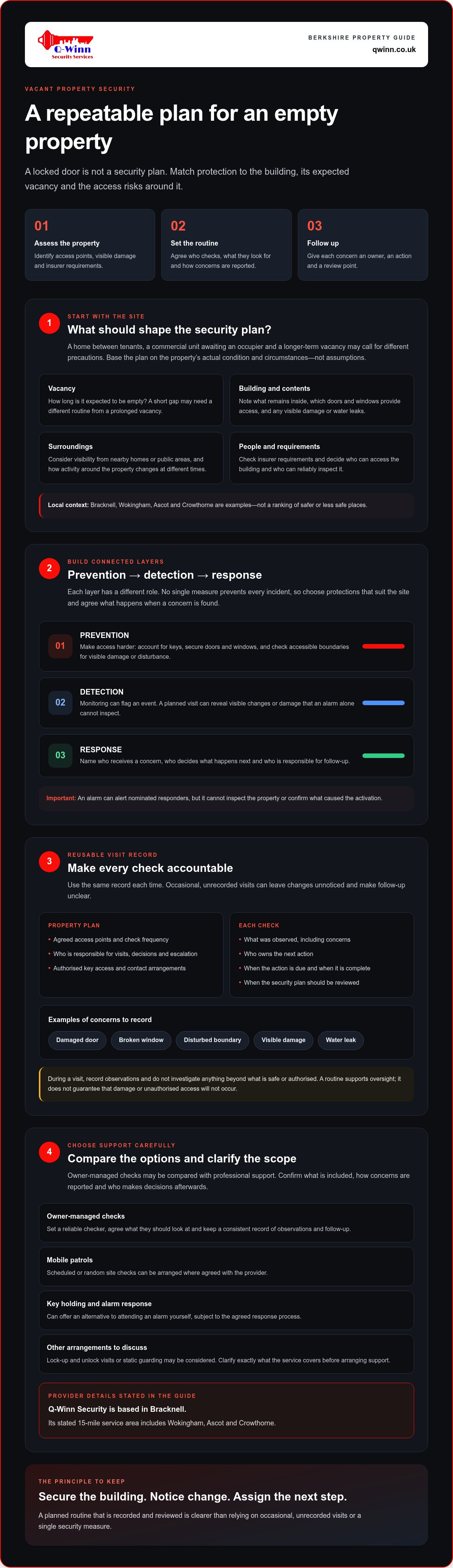
Start with the property and its expected vacancy. Note likely access points, visible damage, water leaks and any requirements set by your insurer. Then decide who will check the building, what they should look at and how they should report a concern. A planned routine makes it easier to spot changes and assign follow-up, rather than relying on occasional, unrecorded visits.
This guide sets out a repeatable way to assess and review security around the building and its local setting. It explains when key holding and alarm response, mobile patrols, lock-up and unlock visits, or static guarding may help, and what to clarify before arranging professional support.
Key Takeaways
- Match security for empty properties Berkshire to the building, expected vacancy and access risks.
- Combine physical security, monitoring and planned checks instead of relying on one measure alone.
- Use a reusable record for observations, actions and review dates so concerns have clear follow-up.
- Compare owner-managed checks with mobile patrols, key holding and other support, then confirm the service scope and area before appointing a provider.
Why empty-property security in Berkshire needs a planned approach
Security for empty properties Berkshire owners arrange should reflect the building, its expected vacancy and its access risks. A home between tenants, a commercial unit awaiting a new occupier and a building empty for longer may need different precautions. Consider how long the property will be vacant, what contents remain, which doors and windows provide access, and what activity is visible nearby. The aim is not to assume the worst, but to identify foreseeable issues and choose suitable layers of protection.
Which empty properties need a tailored security plan?
Vacancy changes a property’s usual routine. There may be fewer people to notice a damaged window, an unsecured entrance or signs of unauthorised occupation. These outcomes are not inevitable, but they are reasons to plan checks around the property’s actual condition and circumstances. A short gap between tenants may call for a different routine from a prolonged vacancy, particularly if contents, access arrangements or activity nearby changes.
What should a Berkshire owner assess first?
Start with the setting and the building. Note how visible it is from nearby homes or public areas, which access points need attention, and who can check it reliably. Consider whether the surroundings are active or quiet at different times, without treating location alone as a measure of risk. Bracknell, Wokingham, Ascot and Crowthorne are useful local examples, not a ranking of safer or less safe places. For commercial premises, the commercial security guide for Bracknell offers related context.
A documented routine makes each check accountable; occasional, unrecorded visits can leave changes unnoticed and follow-up unclear. Record what was observed, who is responsible for next steps and when the plan will be reviewed.
How layered security reduces risks at a vacant property
Security for empty properties Berkshire owners put in place works best as connected layers. Physical measures help secure the building, monitoring can flag an event, and planned checks can reveal visible changes or damage. Guidance on the problems associated with empty properties also highlights why a vacant building should not simply be left without oversight. No single measure prevents every incident, so choose protections that suit the site and agree what should happen if a concern is found.
Prevention makes access harder, detection raises an alert, and response gives someone a next step; each layer supports the others. An alarm can alert nominated responders, but it cannot inspect the property or confirm what caused the activation.
What can owners include in a basic security routine?
Set out who is authorised to access the building and how access is approved. Keep keys accounted for, secure doors and windows, and check accessible boundaries for visible damage or signs of disturbance. During an agreed visit, record observations and avoid investigating anything beyond what is safe or authorised.
- Record concerns such as a damaged door, broken window or disturbed boundary.
- Assign repairs and follow-up to a responsible person, then note when the action is complete.
These steps support oversight, but they do not guarantee that damage or unauthorised access will not occur.
When do patrols or alarm response add another layer?
Mobile patrols can provide scheduled or random site checks where that arrangement is agreed with the provider. Key holding and alarm response can offer an alternative to attending an alarm yourself, subject to the agreed response process. Before choosing either service, clarify what checks or response are included, how concerns are reported and who makes decisions afterwards. For more on inspection planning, see the Berkshire vacant-property inspections guide.
Q-Winn Security is based in Bracknell and states a 15-mile service area that includes Wokingham, Ascot and Crowthorne. To discuss whether its key holding or mobile patrol services may suit your property, visit Q-Winn Security’s website.
A reusable empty-property security checklist for Berkshire owners
A consistent record makes security for empty properties Berkshire easier to manage when responsibility or circumstances change. Use the same fields for every visit, and make sure each concern has an owner and a follow-up date.
What should the property security record include?
Keep a main property record and add an entry for each check. Note agreed access points, check frequency, and who is responsible for visits, decisions and escalation. Record authorised key access and contact arrangements, but store sensitive details securely and limit access to people who need them.
- Property and responsible contact: address, named owner or manager, and relevant contact roles.
- Check record: date, observations and visible changes to doors, windows, boundaries or the building.
- Follow-up: action required, action owner, completion status and review date.
Dated records show what is unresolved, who is handling it and which actions are complete.
How should the routine change when the vacancy changes?
Review the plan after damage, changes to authorised access or building work, and whenever the expected vacancy becomes longer. Reassess the routine if valuable contents are brought in or visits to the premises become more frequent. Use the checklist to guide decisions, not as a form to complete without considering what has changed.
- Before vacancy: confirm access arrangements, responsible contacts and the initial review date.
- During vacancy: log checks, findings, assigned actions and their status.
- When an issue arises: follow the agreed contact and escalation arrangements.
- Before return to use: review outstanding actions and update access and contact details.
For more inspection-focused guidance, see the Berkshire vacant-property inspections guide. If you’re considering key holding and alarm response as part of your routine, discuss your requirements with Q-Winn Security.
Choosing local security support for an empty property in Berkshire
Once you’ve identified gaps in your routine, choose support to address them. Owner-managed checks may suit a property if someone can visit reliably and act on concerns. Mobile patrols provide a contracted site-check option, while key holding and alarm response can help if you do not want to attend an alarm yourself. These services support the owner’s wider plan, but you still need to agree who makes decisions and follows up.
What should you ask a security provider before appointing them?
Clarify the practical arrangements before agreeing a service. Ask who conducts checks, what they record, how concerns are escalated and which contact is approached if you cannot be reached. Confirm how keys are held and used, what the alarm-response arrangement covers, the agreed scope of work and the relevant terms. If officers are part of the proposed service, check current SIA licensing information. Do not assume every provider includes the same checks or response arrangements.
Where can Q-Winn Security’s services fit into a security plan?
Q-Winn Security offers key holding and alarm response, mobile patrols, lock-up and unlock services, and static guarding. Each can meet a different need: managing keys and alarm attendance, adding patrol visits, arranging for a property to be locked or unlocked, or having a guard on site. Read the key holding and alarm response guide for more detail.
Based in Bracknell, Q-Winn Security states a 15-mile service area that includes Wokingham, Ascot and Crowthorne. This is a starting point, not confirmation that every address is covered. Check whether your property falls within the current area and confirm the service arrangements before making a decision. If your review has revealed a gap, discuss your requirements with the team to decide whether its services fit your plan.
Put a clear plan in place for your empty property
Effective security for empty properties Berkshire starts with a tailored plan, not a one-off lock-up. Match measures to the building and the expected vacancy, then keep a dated record of checks, concerns and follow-up actions. Review the plan whenever access, occupancy or the property’s condition changes.
If regular visits or alarm attendance are difficult to manage, professional support may help fill a gap. Q-Winn Security is a family-run company based in Bracknell, with over 30 years of combined industry experience. Its SIA-licensed officers provide services including key holding and alarm response, with 24/7 alarm response availability. Confirm the service scope and that your address is within the stated service area before making arrangements.
Discuss your empty-property security requirements with Q-Winn Security and explore whether its services suit your plan. With clear responsibilities and a routine you can review, you can take the next step with greater confidence.
Frequently Asked Questions
How do you secure an empty property in Berkshire?
Match precautions to the property’s vacancy, layout and access risks, then establish a documented checking routine. For security for empty properties Berkshire, begin by securing doors and windows, controlling authorised access, accounting for keys and checking visible boundaries for damage. Record findings and assign follow-up actions. In Bracknell, consider whether you can visit reliably or need agreed local support with checks or alarm response.
How often should an empty property be checked?
There is no single checking frequency that suits every empty property. Set a schedule based on the building’s condition, how long it will be vacant, access arrangements and whether contents or building work change. Check your insurer’s requirements too, as policy conditions may specify inspection arrangements. Record each visit and review the schedule after damage, changes to access or a longer-than-planned vacancy.
Can a security company respond to an alarm at an empty property?
A security company may provide key holding and alarm response, subject to its agreed service scope and coverage. An alarm can alert nominated responders, but it does not inspect the property itself. Confirm how activations are handled, who is contacted and what the responder is authorised to do. Q-Winn Security, based in Bracknell, offers 24/7 alarm response availability; check that your address is within its service area and confirm the arrangements.
Is key holding useful when a property is vacant?
Key holding can be useful if you do not want to attend an alarm yourself or cannot reliably reach the property. A contracted key holder can hold authorised access for the agreed service, but arrangements vary. Ask how keys are secured and used, who may attend, how you’ll be contacted and what happens if a concern is found. Confirm service availability and terms for your property’s location before appointing a provider.
What should an empty-property security checklist include?
Include the property address, responsible contact, agreed access points, authorised key arrangements and planned check frequency. For each visit, record the date, visible observations, any damage, the follow-up action, its owner and completion status. Add contact and escalation roles, storing sensitive access details securely with appropriate access limits. Organise actions into preparation before vacancy, routine checks, issue escalation and a review before the property returns to use.
Frequently Asked Questions
Vacancy changes a property’s usual routine. There may be fewer people to notice a damaged window, an unsecured entrance or signs of unauthorised occupation. These outcomes are not inevitable, but they are reasons to plan checks around the property’s actual condition and circumstances. A short gap between tenants may call for a different routine from a prolonged vacancy, particularly if contents, access arrangements or activity nearby changes.
Start with the setting and the building. Note how visible it is from nearby homes or public areas, which access points need attention, and who can check it reliably. Consider whether the surroundings are active or quiet at different times, without treating location alone as a measure of risk. Bracknell, Wokingham, Ascot and Crowthorne are useful local examples, not a ranking of safer or less safe places. For commercial premises, the commercial security guide for Bracknell offers related context. A documented routine makes each check accountable; occasional, unrecorded visits can leave changes unnoticed and follow-up unclear. Record what was observed, who is responsible for next steps and when the plan will be reviewed. Security for empty properties Berkshire owners put in place works best as connected layers. Physical measures help secure the building, monitoring can flag an event, and planned checks can reveal visible changes or damage. Guidance on the problems associated with empty properties also highlights why a vacant building should not simply be left without oversight. No single measure prevents every incident, so choose protections that suit the site and agree what should happen if a concern is found. Prevention makes access harder, detection raises an alert, and response gives someone a next step; each layer supports the others. An alarm can alert nominated responders, but it cannot inspect the property or confirm what caused the activation.
Set out who is authorised to access the building and how access is approved. Keep keys accounted for, secure doors and windows, and check accessible boundaries for visible damage or signs of disturbance. During an agreed visit, record observations and avoid investigating anything beyond what is safe or authorised. These steps support oversight, but they do not guarantee that damage or unauthorised access will not occur.
Mobile patrols can provide scheduled or random site checks where that arrangement is agreed with the provider. Key holding and alarm response can offer an alternative to attending an alarm yourself, subject to the agreed response process. Before choosing either service, clarify what checks or response are included, how concerns are reported and who makes decisions afterwards. For more on inspection planning, see the Berkshire vacant-property inspections guide. Q-Winn Security is based in Bracknell and states a 15-mile service area that includes Wokingham, Ascot and Crowthorne. To discuss whether its key holding or mobile patrol services may suit your property, visit Q-Winn Security’s website. A consistent record makes security for empty properties Berkshire easier to manage when responsibility or circumstances change. Use the same fields for every visit, and make sure each concern has an owner and a follow-up date.
Keep a main property record and add an entry for each check. Note agreed access points, check frequency, and who is responsible for visits, decisions and escalation. Record authorised key access and contact arrangements, but store sensitive details securely and limit access to people who need them. Dated records show what is unresolved, who is handling it and which actions are complete.
Review the plan after damage, changes to authorised access or building work, and whenever the expected vacancy becomes longer. Reassess the routine if valuable contents are brought in or visits to the premises become more frequent. Use the checklist to guide decisions, not as a form to complete without considering what has changed. For more inspection-focused guidance, see the Berkshire vacant-property inspections guide. If you’re considering key holding and alarm response as part of your routine, discuss your requirements with Q-Winn Security. Once you’ve identified gaps in your routine, choose support to address them. Owner-managed checks may suit a property if someone can visit reliably and act on concerns. Mobile patrols provide a contracted site-check option, while key holding and alarm response can help if you do not want to attend an alarm yourself. These services support the owner’s wider plan, but you still need to agree who makes decisions and follows up.
Clarify the practical arrangements before agreeing a service. Ask who conducts checks, what they record, how concerns are escalated and which contact is approached if you cannot be reached. Confirm how keys are held and used, what the alarm-response arrangement covers, the agreed scope of work and the relevant terms. If officers are part of the proposed service, check current SIA licensing information. Do not assume every provider includes the same checks or response arrangements.
Q-Winn Security offers key holding and alarm response, mobile patrols, lock-up and unlock services, and static guarding. Each can meet a different need: managing keys and alarm attendance, adding patrol visits, arranging for a property to be locked or unlocked, or having a guard on site. Read the key holding and alarm response guide for more detail. Based in Bracknell, Q-Winn states a 15-mile service area that includes Wokingham, Ascot and Crowthorne. This is a starting point, not confirmation that every address is covered. Check whether your property falls within the current area and confirm the service arrangements before making a decision. If your review has revealed a gap, discuss your requirements with the team to decide whether its services fit your plan. Effective security for empty properties Berkshire starts with a tailored plan, not a one-off lock-up. Match measures to the building and the expected vacancy, then keep a dated record of checks, concerns and follow-up actions. Review the plan whenever access, occupancy or the property’s condition changes. If regular visits or alarm attendance are difficult to manage, professional support may help fill a gap. Q-Winn Security is a family-run company based in Bracknell, with over 30 years of combined industry experience. Its SIA-licensed officers provide services including key holding and alarm response, with 24/7 alarm response availability. Confirm the service scope and that your address is within the stated service area before making arrangements. Discuss your empty-property security requirements with Q-Winn Security and explore whether its services suit your plan. With clear responsibilities and a routine you can review, you can take the next step with greater confidence.
Match precautions to the property’s vacancy, layout and access risks, then establish a documented checking routine. For security for empty properties Berkshire, begin by securing doors and windows, controlling authorised access, accounting for keys and checking visible boundaries for damage. Record findings and assign follow-up actions. In Bracknell, consider whether you can visit reliably or need agreed local support with checks or alarm response.
There is no single checking frequency that suits every empty property. Set a schedule based on the building’s condition, how long it will be vacant, access arrangements and whether contents or building work change. Check your insurer’s requirements too, as policy conditions may specify inspection arrangements. Record each visit and review the schedule after damage, changes to access or a longer-than-planned vacancy.
A security company may provide key holding and alarm response, subject to its agreed service scope and coverage. An alarm can alert nominated responders, but it does not inspect the property itself. Confirm how activations are handled, who is contacted and what the responder is authorised to do. Q-Winn Security, based in Bracknell, offers 24/7 alarm response availability; check that your address is within its service area and confirm the arrangements.
Key holding can be useful if you do not want to attend an alarm yourself or cannot reliably reach the property. A contracted key holder can hold authorised access for the agreed service, but arrangements vary. Ask how keys are secured and used, who may attend, how you’ll be contacted and what happens if a concern is found. Confirm service availability and terms for your property’s location before appointing a provider.
Include the property address, responsible contact, agreed access points, authorised key arrangements and planned check frequency. For each visit, record the date, visible observations, any damage, the follow-up action, its owner and completion status. Add contact and escalation roles, storing sensitive access details securely with appropriate access limits. Organise actions into preparation before vacancy, routine checks, issue escalation and a review before the property returns to use.