Local Security vs National Firms: What Should Berkshire Businesses Compare?
The closest security provider isn’t automatically the best fit, and a national name doesn’t guarantee stronger protection. Choosing between local security vs national firms means looking beyond the label to what your site actually needs.
It’s reasonable to ask whether a local presence will improve communication or response, and whether a smaller provider can cover your requirements reliably. Those differences can matter, but they shouldn’t be taken for granted. A firm’s size alone won’t tell you how it handles incidents, arranges cover or keeps you informed.
This guide explains how to compare providers using practical, checkable criteria, including coverage, communication, staffing arrangements, accountability and service fit. For Berkshire businesses, local knowledge may be useful when it is backed by confirmed coverage and clear procedures. Q-Winn Security is based in Bracknell and serves nearby areas within a 15-mile radius, but the right choice depends on your location, requirements and the evidence each provider can give you.
Key Takeaways
- In the local security vs national firms comparison, judge evidence and delivery commitments, not provider size or marketing claims.
- Compare how each firm handles coverage, communication, escalation and continuity, then ask for clear, measurable details.
- Start with your site’s risks and required outcomes, and check relevant SIA licence details and responsibilities.
- Find out whether a Bracknell-based firm’s confirmed coverage and services match your site’s needs.
Local security vs national firms: which common assumptions hold up?
Provider size alone can’t prove service quality or suitability. A local firm may know the area, but that doesn’t automatically mean a quicker response. A national provider may have a larger network, but that doesn’t guarantee suitable staffing or procedures for your site. In any local security vs national firms comparison, test what each provider can demonstrate for your location and service requirements.
Location is not capability: judge the arrangements behind the address. Compare the provider’s confirmed coverage, staffing, communication and escalation process. For roles requiring a licence, check the relevant details and understand the Security Industry Authority (SIA)’s role in regulating the private security industry.
Does a local security firm always respond faster?
No. Distance is only one factor, and it doesn’t establish an arrival time or response guarantee. Ask what happens when an alarm activates: how is the alert received, who assigns the response, and how are delays or changing circumstances escalated? Request the provider’s specific commitments for your site, including any limits or exclusions, and clarify what the service includes.
Are national security firms automatically better equipped?
Scale alone doesn’t show whether a firm can provide suitable staff, maintain continuity or follow procedures tailored to your site. Ask how planned cover is arranged, what happens if assigned staff are unavailable, and who you contact about an operational issue. Look for specific answers about your site rather than relying on broad claims such as “national reach” or “personal service”.
Compare evidence, not labels. A local provider may offer a more direct contact route, while a national firm may cover a broader area. Neither advantage is automatic. The important question is whether the provider can explain how its arrangements meet your site’s needs and keep responsibilities clear.
Compare local and national security firms on operational delivery
In a local security vs national firms comparison, focus on what the provider will deliver at your site, not what its size suggests. A shop, industrial unit, office and residential site may need different coverage, communication and escalation arrangements. Provider location matters when it helps meet a defined operational requirement, such as supporting a site within the confirmed service area.
| Area | What to compare | Evidence to request |
|---|---|---|
| Coverage | Local presence or wider network | Named locations, operating hours and confirmed service scope |
| Communication | Direct contact or central account route | Who provides routine updates and how urgent issues are reported |
| Escalation | Local or central decision-making | Who receives an incident, assigns action and updates your contact |
| Continuity | Cover when usual staff or contacts are unavailable | Documented procedures and responsibilities for maintaining service |
Claims such as “personal service” and “national reach” are not service commitments. Ask for details you can check, including the locations and hours covered, how incidents are reported and the steps followed when an issue is escalated. If you are comparing costs, check what the quoted fee covers, whether there is a regular retainer and whether alarm activations or emergency call-outs are charged separately. For information on licensing and contractor approval, consult the UK's Security Industry Authority.
What should a Bracknell business ask about coverage?
Confirm which sites and operating hours are included rather than assuming a provider covers every nearby location. If your business operates in Wokingham, Ascot or Crowthorne as well as Bracknell, give the provider each address and ask how each site will be handled. Verify current availability and the specific services available at each location against your requirements.
How do communication and continuity differ in practice?
Identify who manages routine account updates and who handles urgent escalation. Ask how incidents will be reported, who will update your nominated contact and what happens if your usual contact or assigned officer is unavailable. A useful answer explains the procedure and who is responsible at each stage, rather than relying on a general promise of responsive service.
For a local point of comparison, review Q-Winn’s local security services and confirm which arrangements are available for your site.
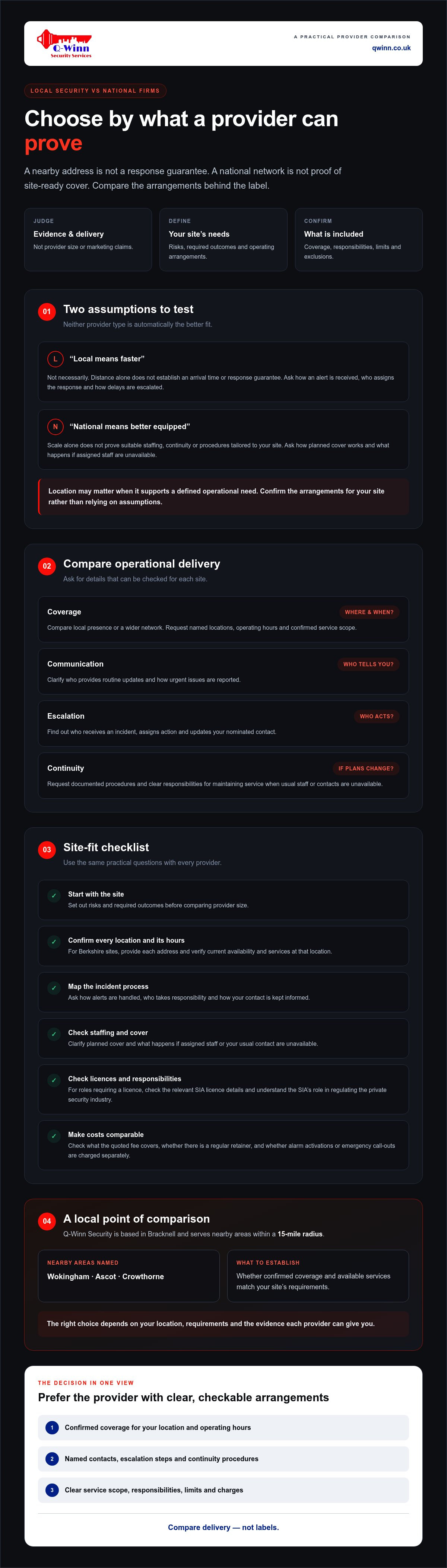
Use this checklist to assess security providers in Berkshire
Start with the site, not the provider’s size. Define the risks you need to address and the outcome you expect, then compare local security vs national firms against the same requirements. For broader site-protection considerations, read this Bracknell commercial security guide.
- Set the requirements. Note your site type, operating pattern, main risks and the outcome you want from the service. Be specific about opening and closing routines, access arrangements and when the site is unattended.
- Match services to risks. Key holding and alarm response may suit sites where alarm activations need a response arrangement. Mobile patrols, static guarding or lock-up and unlock services may fit other site needs. If alarm response is a priority, see the key holding and alarm response guide.
- Check relevant SIA licence details. Confirm that officers undertaking licensable roles hold the appropriate licence, and clarify the provider’s responsibilities and your own.
- Request evidence. Ask for a clear scope of work, contact route and explanation of procedures. Check whether the provider has experience with sites of a similar type and operating pattern.
- Agree how delivery is managed. Ask what reports you’ll receive, how concerns are escalated, what cover arrangements apply if usual staff are unavailable, and how service performance is reviewed. If fees apply per call-out, make sure you understand when those charges arise.
A structured comparison can help you assess capability beyond broad promises. USI Security’s How to Choose a Security Company offers a framework for comparing providers. Apply it to your own priorities, and record each firm’s answers so you can compare like with like.
What evidence should you request before deciding?
Ask each provider to explain how its proposed procedures will work at your site, not just describe a general approach. Before agreeing to a service, make sure the scope, reporting route, escalation process and cover arrangements are clear enough to assess. Where relevant, ask how routine fees and call-out charges are set out in the service terms.
To discuss which of Q-Winn Security’s listed services may suit your site, review security options for your requirements.
When a Bracknell-based security firm may suit your site
A local provider may be a good fit if its confirmed coverage, services and operating arrangements match your site’s needs. In the local security vs national firms decision, proximity is a practical consideration, not a guarantee of suitability or faster service.
Q-Winn Security is a family-run firm based in Bracknell, with over 30 years’ combined industry experience. Its stated service radius is 15 miles from Bracknell, including Wokingham, Ascot and Crowthorne. Check directly that your specific site and requirements can be covered, and ask what arrangements would apply before making a decision.
Which Q-Winn services might match different site needs?
If alarm activations are a concern, ask whether key holding and alarm response suits your requirements, and clarify the agreed procedure and any associated call-out arrangements. Mobile patrols may be worth discussing for sites where a patrol service is relevant. Lock-up and unlock services may suit businesses that need support with opening or securing premises. Static or manned guarding is another option to discuss where a staffed security presence is required. The right service depends on the site and the details agreed.
If you’re considering patrols, the mobile security patrols guide can help you explore what to consider for a Berkshire site.
What should you clarify before approaching a provider?
Prepare a short outline of your site location, operating hours and main security concerns. Include any particular risks, the outcome you need and how you expect updates or incidents to be handled. This gives providers a clear basis for explaining their coverage, service options and proposed arrangements.
Then compare their answers against the criteria in this guide. Ask for confirmation of current availability for your site, and make sure responsibilities, procedures and charges are clear before agreeing to a service. If you’re assessing whether a Bracknell-based provider may suit your business, discuss your site requirements with Q-Winn Security as a practical next step.
Choose security that fits your site
The right choice in the local security vs national firms comparison comes down to fit, not the size of the provider. Look for clear evidence about coverage, communication, escalation and service continuity. Then match the proposed arrangements to your site’s risks, operating pattern and required outcomes.
A local base may be useful when it supports a specific operational need, but it doesn’t prove faster response or better service. Check commitments directly, confirm relevant SIA licence details and make sure responsibilities are clear. For Berkshire businesses considering a nearby provider, Q-Winn Security is a family-run Bracknell company with over 30 years of combined industry experience and SIA-licensed officers. Its stated service radius is 15 miles; confirm current availability for your location and requirements.
Ready to explore whether the arrangements could suit your site? Discuss your site’s security requirements with Q-Winn. A clear conversation about your risks and priorities is a practical first step towards a security plan that fits your business.
Frequently Asked Questions
Is a local security company better than a national firm?
Not automatically. In the local security vs national firms comparison, the better choice is the provider whose confirmed coverage, staffing, communication and procedures suit your site. A local firm may offer useful area knowledge, whilst a national company may serve a wider footprint. Ask both for specific service details, including how incidents are escalated and what happens if usual staff or contacts are unavailable.
Can a local security firm cover sites across Berkshire?
Some can, but coverage varies by provider and service. Q-Winn Security is based in Bracknell and states a 15-mile service radius, including Wokingham, Ascot and Crowthorne. That doesn’t confirm availability for every site or requirement. Give the provider each site address and ask which services, operating hours and arrangements can be supported at each location before you make a decision.
How do I compare local and national security providers?
Compare them against the same site-specific criteria, not broad claims about personal service or national reach. Set out your risks and required outcomes, then check coverage, contact routes, escalation procedures, continuity arrangements and reporting. Ask for a clear scope of work and how performance will be reviewed. Verify relevant SIA licence details for licensable roles, and clarify each party’s responsibilities.
What should I check before hiring a security company in Bracknell?
Confirm that the provider covers your Bracknell site and can meet its specific requirements. Ask for the proposed scope, operating arrangements, contact route and procedures for reporting and escalating incidents. Verify relevant SIA licence details for officers in licensable roles, and clarify who is responsible for each part of the service. Check that the service matches your site’s risks, rather than choosing on location alone.
Does a national security company provide better coverage?
Not necessarily. A national firm may operate across a wider area, but you should confirm that its actual service footprint includes every site and that its arrangements meet your needs. Ask how staffing, communication and continuity are managed across locations. A local provider may cover several nearby towns too. For Berkshire sites, compare confirmed locations and service details rather than assuming company size determines coverage.
Frequently Asked Questions
No. Distance is only one factor, and it doesn’t establish an arrival time or response guarantee. Ask what happens when an alarm activates: how is the alert received, who assigns the response, and how are delays or changing circumstances escalated? Request the provider’s specific commitments for your site, including any limits or exclusions, and clarify what the service includes.
Scale alone doesn’t show whether a firm can provide suitable staff, maintain continuity or follow procedures tailored to your site. Ask how planned cover is arranged, what happens if assigned staff are unavailable, and who you contact about an operational issue. Look for specific answers about your site rather than relying on broad claims such as “national reach” or “personal service”. Compare evidence, not labels. A local provider may offer a more direct contact route, while a national firm may cover a broader area. Neither advantage is automatic. The important question is whether the provider can explain how its arrangements meet your site’s needs and keep responsibilities clear. In a local security vs national firms comparison, focus on what the provider will deliver at your site, not what its size suggests. A shop, industrial unit, office and residential site may need different coverage, communication and escalation arrangements. Provider location matters when it helps meet a defined operational requirement, such as supporting a site within the confirmed service area. Claims such as “personal service” and “national reach” are not service commitments. Ask for details you can check, including the locations and hours covered, how incidents are reported and the steps followed when an issue is escalated. If you are comparing costs, check what the quoted fee covers, whether there is a regular retainer and whether alarm activations or emergency call-outs are charged separately. For information on licensing and contractor approval, consult the UK's Security Industry Authority.
Confirm which sites and operating hours are included rather than assuming a provider covers every nearby location. If your business operates in Wokingham, Ascot or Crowthorne as well as Bracknell, give the provider each address and ask how each site will be handled. Verify current availability and the specific services available at each location against your requirements.
Identify who manages routine account updates and who handles urgent escalation. Ask how incidents will be reported, who will update your nominated contact and what happens if your usual contact or assigned officer is unavailable. A useful answer explains the procedure and who is responsible at each stage, rather than relying on a general promise of responsive service. For a local point of comparison, review Q-Winn’s local security services and confirm which arrangements are available for your site. Start with the site, not the provider’s size. Define the risks you need to address and the outcome you expect, then compare local security vs national firms against the same requirements. For broader site-protection considerations, read this Bracknell commercial security guide. A structured comparison can help you assess capability beyond broad promises. USI Security’s How to Choose a Security Company offers a framework for comparing providers. Apply it to your own priorities, and record each firm’s answers so you can compare like with like.
Ask each provider to explain how its proposed procedures will work at your site, not just describe a general approach. Before agreeing to a service, make sure the scope, reporting route, escalation process and cover arrangements are clear enough to assess. Where relevant, ask how routine fees and call-out charges are set out in the service terms. To discuss which of Q-Winn Security’s listed services may suit your site, review security options for your requirements. A local provider may be a good fit if its confirmed coverage, services and operating arrangements match your site’s needs. In the local security vs national firms decision, proximity is a practical consideration, not a guarantee of suitability or faster service. Q-Winn Security is a family-run firm based in Bracknell, with over 30 years’ combined industry experience. Its stated service radius is 15 miles from Bracknell, including Wokingham, Ascot and Crowthorne. Check directly that your specific site and requirements can be covered, and ask what arrangements would apply before making a decision.
If alarm activations are a concern, ask whether key holding and alarm response suits your requirements, and clarify the agreed procedure and any associated call-out arrangements. Mobile patrols may be worth discussing for sites where a patrol service is relevant. Lock-up and unlock services may suit businesses that need support with opening or securing premises. Static or manned guarding is another option to discuss where a staffed security presence is required. The right service depends on the site and the details agreed. If you’re considering patrols, the mobile security patrols guide can help you explore what to consider for a Berkshire site.
Prepare a short outline of your site location, operating hours and main security concerns. Include any particular risks, the outcome you need and how you expect updates or incidents to be handled. This gives providers a clear basis for explaining their coverage, service options and proposed arrangements. Then compare their answers against the criteria in this guide. Ask for confirmation of current availability for your site, and make sure responsibilities, procedures and charges are clear before agreeing to a service. If you’re assessing whether a Bracknell-based provider may suit your business, discuss your site requirements with Q-Winn Security as a practical next step. The right choice in the local security vs national firms comparison comes down to fit, not the size of the provider. Look for clear evidence about coverage, communication, escalation and service continuity. Then match the proposed arrangements to your site’s risks, operating pattern and required outcomes. A local base may be useful when it supports a specific operational need, but it doesn’t prove faster response or better service. Check commitments directly, confirm relevant SIA licence details and make sure responsibilities are clear. For Berkshire businesses considering a nearby provider, Q-Winn Security is a family-run Bracknell company with over 30 years of combined industry experience and SIA-licensed officers. Its stated service radius is 15 miles; confirm current availability for your location and requirements. Ready to explore whether the arrangements could suit your site? Discuss your site’s security requirements with Q-Winn. A clear conversation about your risks and priorities is a practical first step towards a security plan that fits your business.
Not automatically. In the local security vs national firms comparison, the better choice is the provider whose confirmed coverage, staffing, communication and procedures suit your site. A local firm may offer useful area knowledge, whilst a national company may serve a wider footprint. Ask both for specific service details, including how incidents are escalated and what happens if usual staff or contacts are unavailable.
Some can, but coverage varies by provider and service. Q-Winn Security is based in Bracknell and states a 15-mile service radius, including Wokingham, Ascot and Crowthorne. That doesn’t confirm availability for every site or requirement. Give the provider each site address and ask which services, operating hours and arrangements can be supported at each location before you make a decision.
Compare them against the same site-specific criteria, not broad claims about personal service or national reach. Set out your risks and required outcomes, then check coverage, contact routes, escalation procedures, continuity arrangements and reporting. Ask for a clear scope of work and how performance will be reviewed. Verify relevant SIA licence details for licensable roles, and clarify each party’s responsibilities.
Confirm that the provider covers your Bracknell site and can meet its specific requirements. Ask for the proposed scope, operating arrangements, contact route and procedures for reporting and escalating incidents. Verify relevant SIA licence details for officers in licensable roles, and clarify who is responsible for each part of the service. Check that the service matches your site’s risks, rather than choosing on location alone.
Not necessarily. A national firm may operate across a wider area, but you should confirm that its actual service footprint includes every site and that its arrangements meet your needs. Ask how staffing, communication and continuity are managed across locations. A local provider may cover several nearby towns too. For Berkshire sites, compare confirmed locations and service details rather than assuming company size determines coverage.