Key Holding Cost Per Year: Typical Rates and Cost Factors
There is no single annual rate for key holding. To understand how much key holding costs per year, consider your site’s requirements and the response cover it needs. Pricing is provided through a free quote, with key storage and emergency response arranged on an annual or monthly retainer.
That makes the service scope important. Site requirements and the level of response needed can affect the rate, so a headline figure alone may not tell you what the arrangement covers. This guide explains how annual costs are assessed, what can influence the rate and how to understand the difference between key holding and alarm response. You’ll have a clearer basis for considering the cover your premises need and the factors that shape its cost.
Key Takeaways
- There isn’t one standard annual rate for key holding; the fee reflects the service arrangement and the needs of the site.
- Understand how the level of response and the scope of cover can affect the rate you pay.
- Look at what the contract says about secure key storage, alarm response and the retainer period.
- See how key holding can sit alongside services such as mobile patrols or lock-up and unlock support.
Typical annual holding-cost percentage
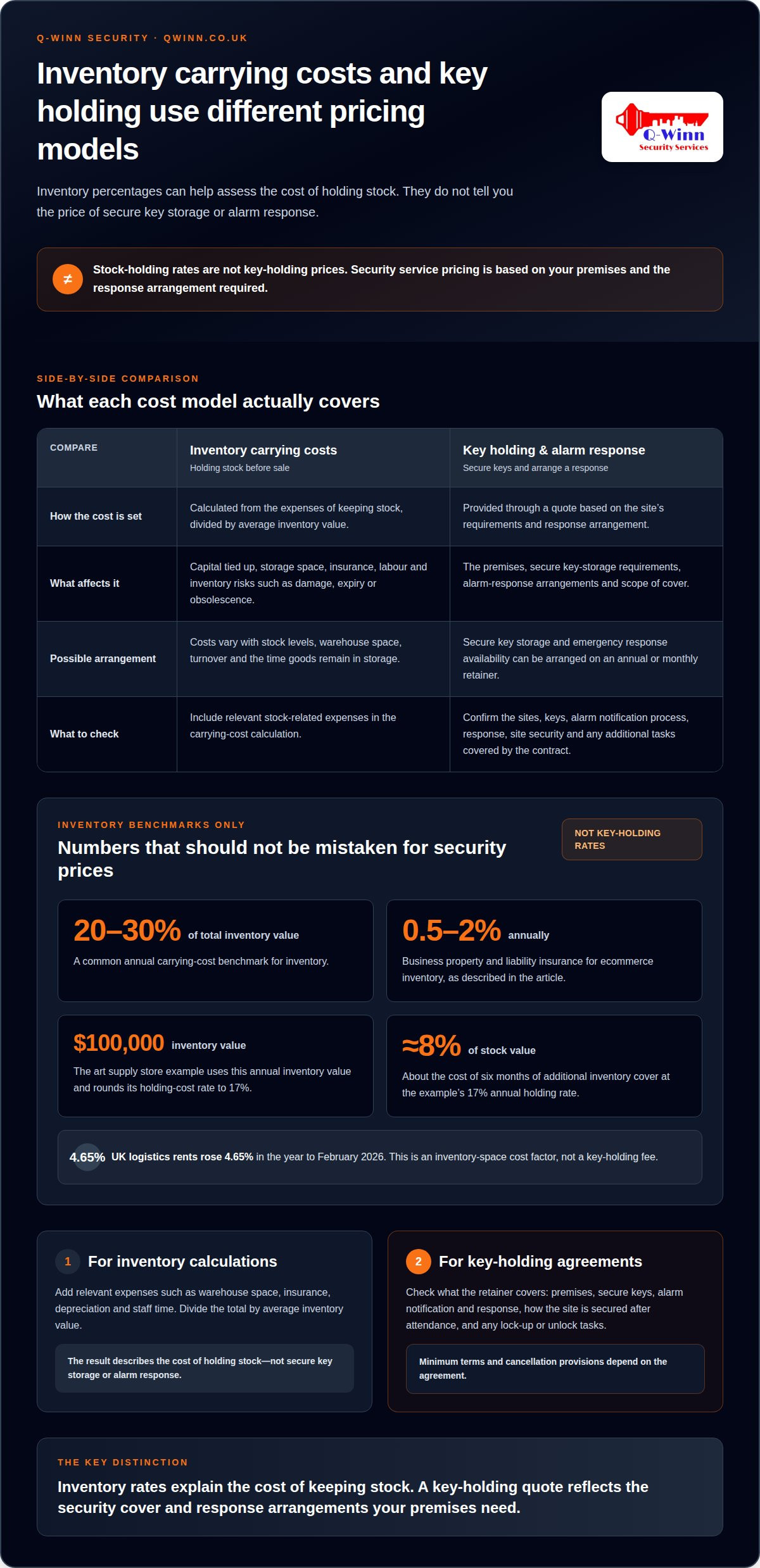
For inventory, a common annual carrying-cost benchmark is 20% to 30% of total inventory value. This percentage covers the cost of holding stock, not secure key storage or alarm response. The two services use different pricing models, so an inventory rate cannot tell you how much key holding costs per year.
To calculate inventory carrying costs, add expenses such as warehouse space, insurance, depreciation and staff time, then divide the total by average inventory value. That is a worked annual inventory example, not a security-service quote.
In-house cover has no single annual cost. The calculation depends on staff pay, time spent holding keys and responding, and arrangements for covering absences. Compare these costs with an external service retainer, which may be annual or monthly. For professional key holding, pricing is provided through a free quote based on the site’s requirements and response arrangement.
UK legal and insurance requirements for professional key holders depend on the role and contract. An inventory percentage does not establish either requirement. Minimum contract terms and cancellation provisions also depend on the agreement, so review the specific terms to understand their effect on annual cost. Turnover, reorder decisions and stock movement through warehouse space affect inventory costs, not key-holding fees.
Other inventory examples use different assumptions and cost categories. Business property and liability insurance for ecommerce inventory typically costs between 0.5% to 2% of total inventory value annually. The page’s art supply store example uses an annual inventory value of $100,000 and rounds its annual inventory holding-cost rate to 17 per cent.
At the example's 17 per cent annual holding rate, six months of additional inventory cover costs about 8 per cent of the stock value. These are inventory figures, not key-holding prices.
Factors that affect the holding-cost rate
For inventory, the carrying-cost rate reflects the expense of keeping stock before sale. Capital tied up, warehouse space, insurance, labour and inventory risk all contribute. Average inventory value matters: the same holding costs represent a different percentage when the total inventory value changes.
Space is one influence. A warehouse with costly racking, utilities or unused capacity can raise the cost of storing each item. UK logistics rents rose 4.65% in the year to February 2026. Demand also affects stock levels: slower inventory turnover can leave goods occupying space for longer, while frequent ordering may change handling needs.
Inventory condition matters too. Depreciation, damage, expiry and obsolescence can reduce the value of stock being held. Inventory carrying costs may also include insurance and the work needed to keep records accurate. These factors explain why businesses with similar average inventory values can calculate different inventory holding-cost percentages.
Key holding is priced differently. The quote reflects the premises, secure key-storage requirements, alarm-response arrangements and scope of cover. Key Holding & Alarm Response can be arranged on an annual or monthly retainer, with pricing provided through a free quote.
For a useful comparison, separate stock-related costs from the security arrangements your site needs. Inventory figures such as racking, demand and turnover won’t determine a key-holding quote. Consider the required response arrangements and the site’s access needs. Review key-holding arrangements as part of that assessment.
Inventory carrying costs include capital, storage space, service and inventory risk costs. Inventory service costs include insurance, IT hardware, taxation in some countries and the work needed to manage stock accurately. Inventory risk costs include shrinkage, deterioration, expiry and obsolescence. Businesses can reduce carrying costs by limiting the volume of stock they store and the time it remains in storage.
What is included in a UK key holding service contract?
A UK contract should make clear what the agreed service covers, rather than relying on the phrase “key holding” alone. For example, it can identify the premises, the keys held securely, and how an alarm notification is handled. The arrangement may use an annual or monthly retainer for secure key storage and 24/7 emergency response availability.
Check that the agreement explains how the provider is notified, what response is arranged and how the site is secured after attendance. It should also set out how access details and changes to authorised contacts are managed. These details distinguish secure key storage from the response arrangements that accompany it.
Set out the service boundaries in writing. Does the agreement cover one site or several? Is it limited to alarm response, or does it also include lock-up and unlock tasks? The agreed scope should clarify which tasks are included, how additional work is handled and who provides accurate access information. Clear terms reduce uncertainty when an alarm is activated.
Payment structure and contract duration also shape the arrangement. A retainer may be annual or monthly, while minimum terms and cancellation provisions depend on the agreement. The cost reflects the premises, key-storage needs, response scope and contract terms; the exact figure is given in a quote for your case. Discuss your key-holding requirements and the cover needed for your site.
Minimum terms and cancellation provisions depend on the agreement, so review the contract to understand which terms apply.
Q-Winn Security: Key Holding & Alarm Response
Q-Winn Security provides Key Holding & Alarm Response for businesses that need secure key storage and a response to alarm activations. It can suit commercial, industrial, retail and residential premises where asking an employee to attend may be impractical. The service is available on an annual or monthly retainer, with the arrangement tailored to the site’s requirements.
Depending on your premises, you may also consider Lock-Up & Unlock Services, Mobile Patrol or Static / Manned Guarding. These services address different security needs, so the right combination depends on the tasks and cover your site requires. Q-Winn Security has over 30 years of combined experience, with SIA-licensed officers and 24/7 rapid response.
To discuss an arrangement for your premises, contact Q-Winn Security.
Make your next step a considered one
Treat the decision as part of premises planning, not simply as an annual budget line. Understanding how much key holding costs per year means considering who is responsible for access and how an alarm event fits into your procedures. If site use or access arrangements change, review whether the agreed scope still suits how the premises operate.
This gives you a clearer basis for weighing the arrangement against your security priorities. A focused discussion can turn a broad requirement into a plan tailored to your site, rather than assuming every premises needs the same approach. Identify what matters most to your operations and what you need the service to address.
Discuss your site’s requirements with Q-Winn Security and take a considered next step for your business.
Frequently Asked Questions
What factors affect the cost of key holding services in the UK?
The quote reflects the premises, response arrangements and expected service requirements. Alarm activations or emergency call-outs may incur additional charges. For a Bracknell site, the agreed coverage area and tasks needed also shape the quote. Share details about your premises and requirements with Q-Winn Security to request a free, tailored quote.
Are there minimum contract terms or cancellation fees for key holding services?
Minimum terms and cancellation provisions depend on the agreement, so review the contract to understand which terms apply.
Frequently Asked Questions
The quote reflects the premises, response arrangements and expected service requirements. Alarm activations or emergency call-outs may incur additional charges. For a Bracknell site, the agreed coverage area and tasks needed also shape the quote. Share details about your premises and requirements with Q-Winn Security to request a free, tailored quote.
Minimum terms and cancellation provisions depend on the agreement, so review the contract to understand which terms apply.