
Facilities Manager Security Checklist: A Practical Guide
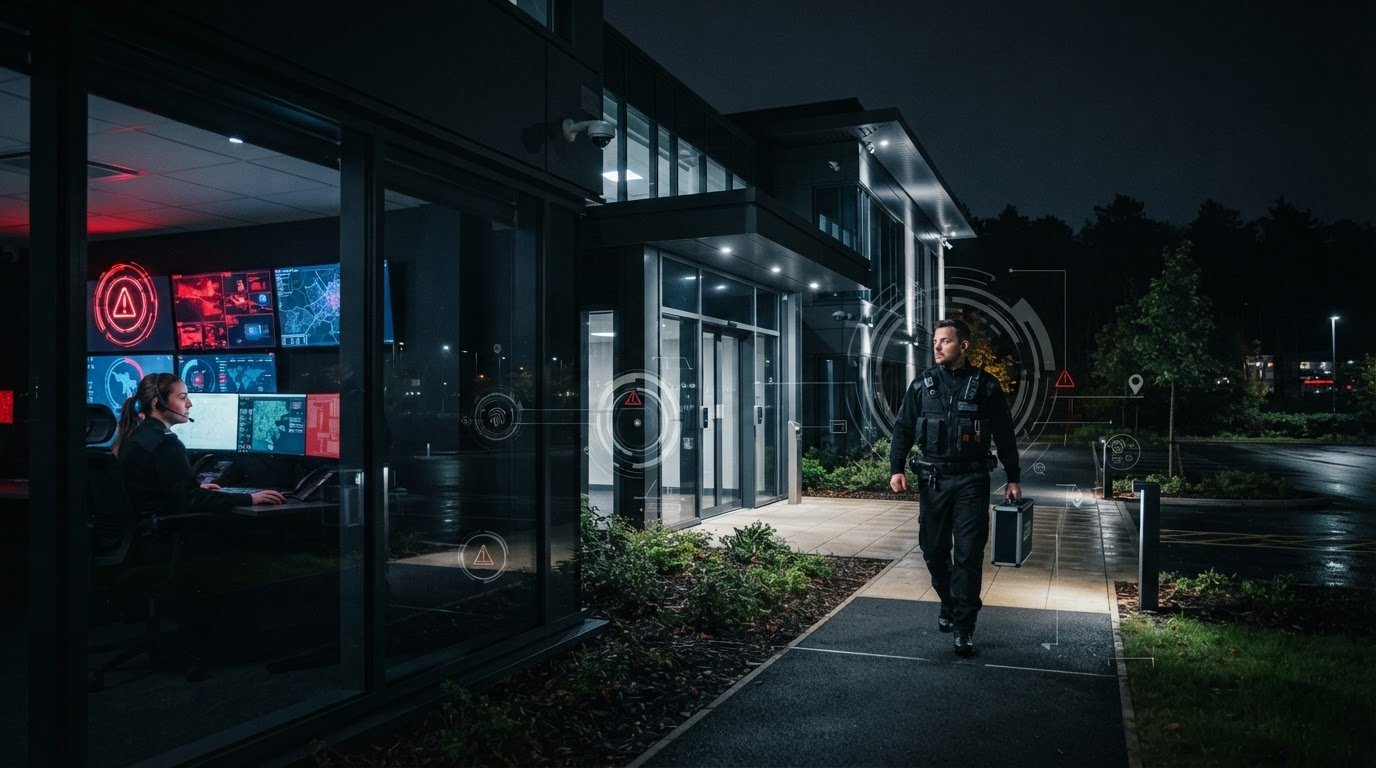
If an alarm sounds at 02:00, does everyone know who responds, what they should check and when to escalate? A facilities manager security checklist turns that uncertainty into a clear, site-specific plan, rather than another list of tasks nobody owns.
Security responsibilities can be split between facilities teams, staff and contractors. The challenge is deciding which vulnerabilities need attention first and what happens when an incident occurs outside normal hours. Use this guide to build repeatable checks, assign ownership and set practical escalation steps. You’ll also find ways to assess whether key holding and alarm response, mobile patrols, lock-up and unlock services or manned guarding could address your site’s needs.
Key Takeaways
- Use a facilities manager security checklist to assess entrances, boundaries, lighting and quieter areas against your site’s specific risks.
- Make checks repeatable by assigning an owner, setting a review frequency and tracking findings through to completion.
- Include key control, access permissions, contractor arrivals and alarm procedures so responsibilities stay clear when routines change or incidents occur.
- Match support to the gap, from alarm response and mobile patrols to manned guarding or lock-up and unlock services from Q-Winn Security.
Facilities manager security checklist: identify the site’s real risks
A facilities manager security checklist helps you identify gaps, assign responsibility and record follow-up actions. Walk the site during normal operations, then consider what changes when the building is quiet or closed. Facility management covers the operation and upkeep of buildings, as outlined in this Facility Management Overview, so security checks should reflect how each site is actually used.
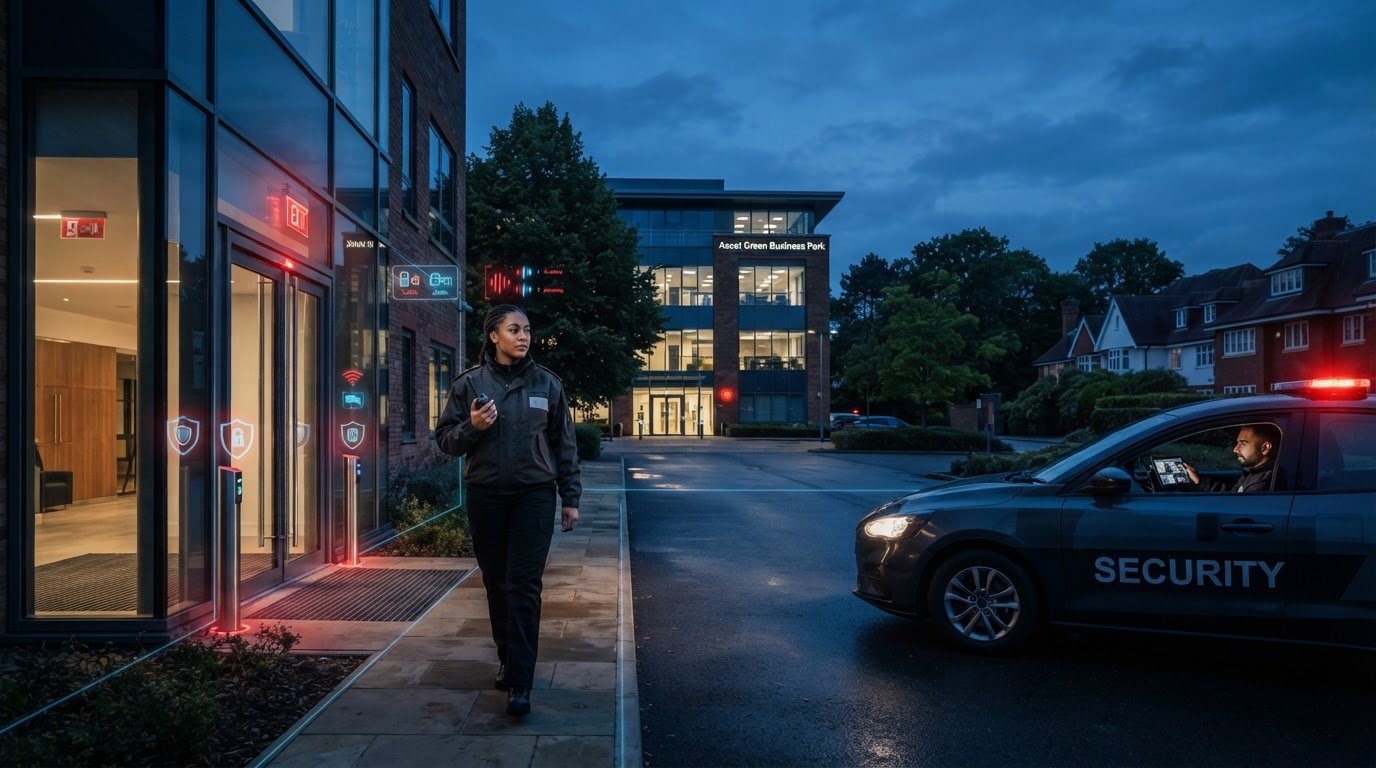
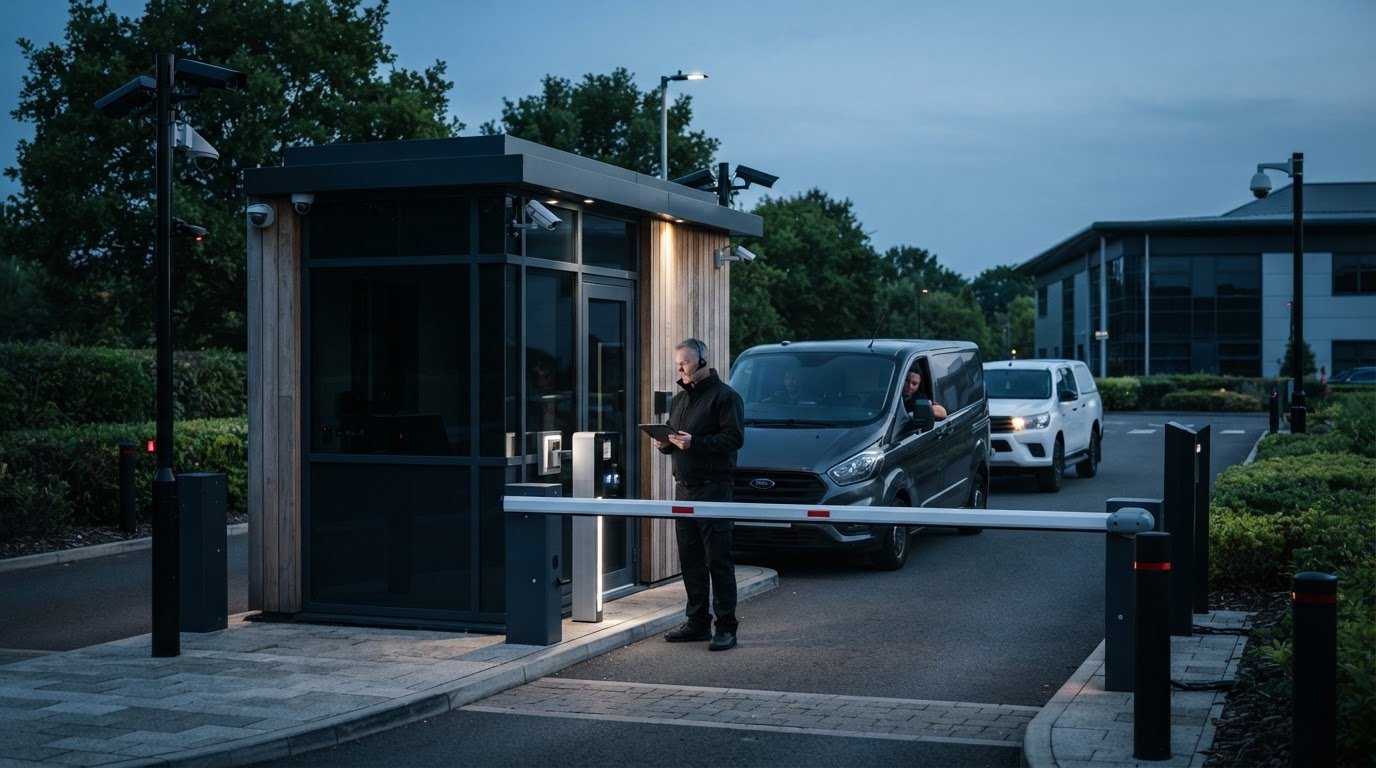
Inspect entrances and boundary points. Check that doors close properly and access routines are followed. Look at lighting around approaches and quieter areas, and note places rarely visited, such as stores, plant rooms or secondary corridors. Observe where deliveries arrive and where visitors wait. Record what you see, rather than assuming a control is working simply because it is in place.
Which site risks should a facilities manager check first?
Prioritise issues by weighing how likely exposure is, the potential impact and whether existing controls leave a gap. For example, a poorly lit side entrance used for late deliveries may need attention before a secure area with little footfall. Include operating hours, lone working, delivery patterns, vacant periods and sensitive areas in your review. These details help distinguish routine wear and tear from weaknesses that could affect people, access or site operations.
- Note the site’s busiest and quietest periods, including when areas are unoccupied.
- Check that staff working alone know how to manage access and report or escalate concerns.
- Identify unattended, sensitive or hard-to-observe areas, and note when they are checked.
Routine observations help teams spot changes and follow up promptly. They do not replace a formal risk assessment or the need to meet applicable legal duties. A facilities manager security checklist is most useful when it reflects the site’s actual hours, people, activities and vulnerabilities, rather than relying on a generic template.
Turn the security checklist into owned, repeatable actions
A checklist only works when each task has an owner and a clear route to completion. Agree who checks each control, how often it is reviewed, where findings are recorded and who tracks outstanding actions. Set the frequency to suit the site and its risks, then review it whenever working patterns or site use change.
- Assign an owner to each check, with a named deputy where practical.
- Set a suitable frequency, checking more often where conditions or controls can change quickly.
- Record findings consistently, including when and where each check took place.
- Track corrective actions through to completion, recording who is responsible and when progress will be reviewed.
Include access permissions, key control, alarm procedures, contractor arrivals and incident reporting. For example, record how a contractor’s arrival is authorised, who confirms access and how staff report a concern. The CISA Physical Security Best Practices can help inform how physical security responsibilities and resources are organised. For broader local context, use this commercial security guide for Bracknell alongside your site-specific records.
How should facilities teams record checks and escalate issues?
Keep dated records of what was observed, who was responsible, what action was taken and what follow-up remains outstanding. Make the escalation route explicit: identify who receives urgent reports, how staff can reach them and what to do if the usual contact is unavailable. Brief relevant staff on the procedure so a concern does not stall while someone searches for instructions. A finding is not resolved until the required action is complete.
Where alarm response is a gap, Q-Winn Security’s key holding and alarm response service provides a defined way to handle alarm activations and assign responsibility for response.
Choose security support that closes your checklist’s gaps
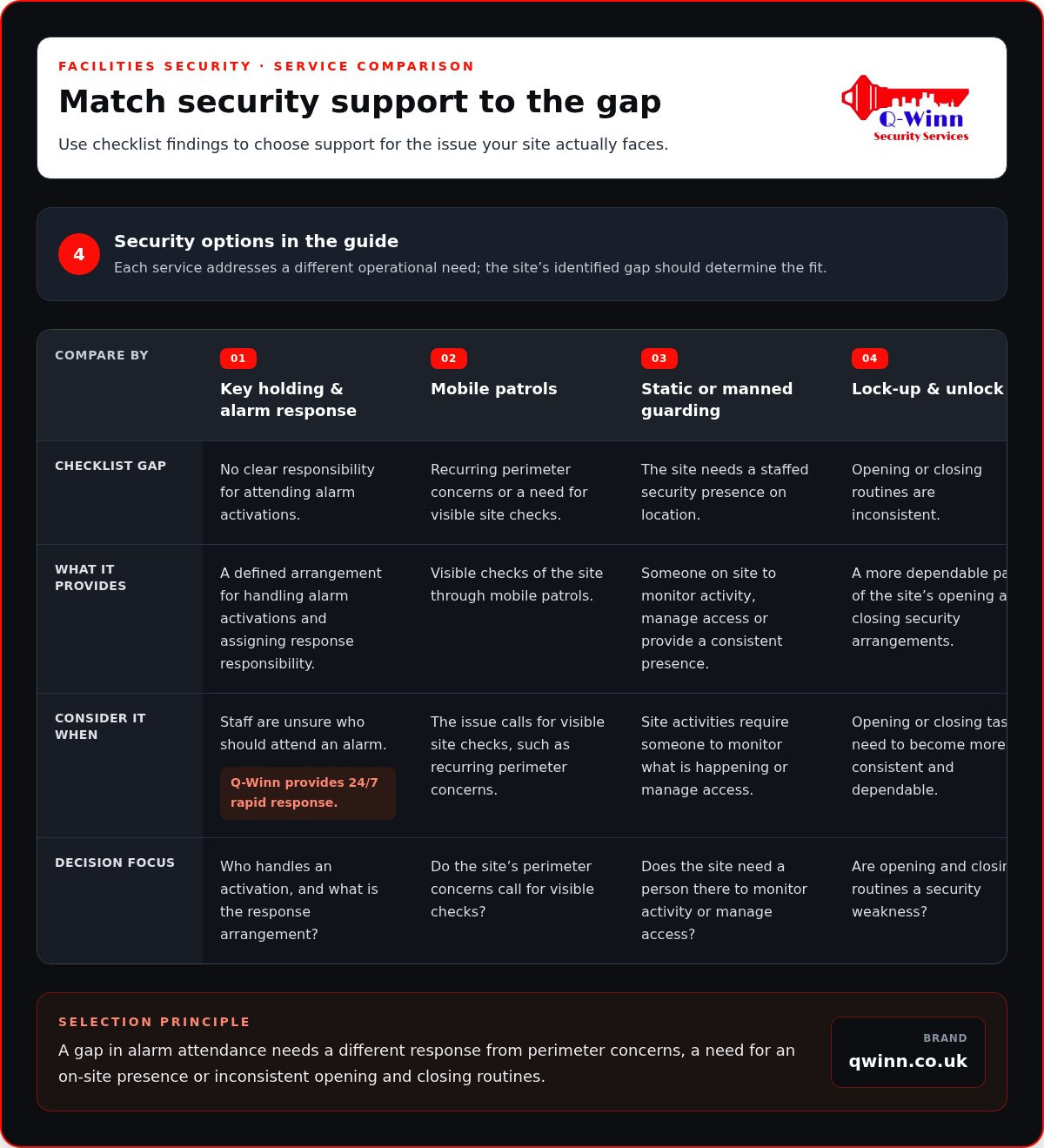
Use your facilities manager security checklist findings to match support to the problem, rather than adding measures without a clear purpose. A gap in who attends an alarm needs a different response from a boundary that needs visible checks or a site that needs a staffed presence. Q-Winn Security provides key holding and alarm response, mobile patrols, static or manned guarding, and lock-up and unlock services.
Which security service fits the issue your checklist reveals?
If alarm activations leave staff unsure who is responsible for attending, key holding and alarm response provides a defined response arrangement. Q-Winn provides 24/7 rapid response. For recurring perimeter concerns or a need for visible site checks, mobile patrols offer a practical option. Read this mobile security patrol guide to consider how patrols could support your site.
A staffed presence may suit a site that needs someone on location to monitor activity, manage access or provide a consistent security presence. Choose the arrangement according to the site’s activities and the gap identified. Where opening or closing routines are inconsistent, lock-up and unlock services can make those tasks a more dependable part of the site’s security arrangements. A manned guarding buying guide can also provide context when comparing the needs of your site with a staffed security presence.
For facilities in Bracknell and the surrounding area, Q-Winn’s local security services can be matched to site requirements. Explore Q-Winn’s local security support to take the next step in addressing the gaps your checklist has identified.
Keep your site security moving forward
Make your facilities manager security checklist a working document, not a one-off exercise. Review it when site use changes, new areas open or an incident reveals an unexpected weakness. This keeps responsibilities and support aligned with the way the building operates.
For Bracknell-area facilities, Q-Winn Security is a local, family-run company with over 30 years of combined industry experience. Its SIA-licensed officers serve Bracknell and nearby towns, including Wokingham, Ascot and Crowthorne.
Take the next step by identifying the gap you want to address. Discuss your site security needs with Q-Winn and put a practical plan in place for your team.
Frequently Asked Questions
Is a facilities manager security checklist a substitute for a formal risk assessment?
No. A facilities manager security checklist does not replace a formal risk assessment. It helps staff notice day-to-day changes, such as a delivery entrance being left unsecured, while a formal assessment examines risks in greater depth and considers appropriate controls. Use the checklist as an operational aid, and review the need for a formal assessment when site risks or changes call for one.
Can one facilities manager security checklist be used across multiple sites?
Use a shared core checklist, but adapt it for each location. A Bracknell office and a nearby warehouse may have different access arrangements, occupancy patterns and areas requiring attention. Add a site-specific section for those differences, and review it when the premises or their use changes. This keeps procedures consistent without overlooking local vulnerabilities.
How can facilities managers make security checks easier for staff to follow?
Make each check clear and practical to complete during a normal shift. Use plain language, explain what a satisfactory result looks like and provide a simple way to report concerns. For example, staff checking a door should know to report damage, a faulty closer or unexpected access, rather than having to decide whether it matters. Ask staff for feedback if instructions are unclear.
Frequently Asked Questions
Prioritise issues by weighing how likely exposure is, the potential impact and whether existing controls leave a gap. For example, a poorly lit side entrance used for late deliveries may need attention before a secure area with little footfall. Include operating hours, lone working, delivery patterns, vacant periods and sensitive areas in your review. These details help distinguish routine wear and tear from weaknesses that could affect people, access or site operations. Routine observations help teams spot changes and follow up promptly. They do not replace a formal risk assessment or the need to meet applicable legal duties. A facilities manager security checklist is most useful when it reflects the site’s actual hours, people, activities and vulnerabilities, rather than relying on a generic template. A checklist only works when each task has an owner and a clear route to completion. Agree who checks each control, how often it is reviewed, where findings are recorded and who tracks outstanding actions. Set the frequency to suit the site and its risks, then review it whenever working patterns or site use change. Include access permissions, key control, alarm procedures, contractor arrivals and incident reporting. For example, record how a contractor’s arrival is authorised, who confirms access and how staff report a concern. The CISA Physical Security Best Practices can help inform how physical security responsibilities and resources are organised. For broader local context, use this commercial security guide for Bracknell alongside your site-specific records.
Keep dated records of what was observed, who was responsible, what action was taken and what follow-up remains outstanding. Make the escalation route explicit: identify who receives urgent reports, how staff can reach them and what to do if the usual contact is unavailable. Brief relevant staff on the procedure so a concern does not stall while someone searches for instructions. A finding is not resolved until the required action is complete. Where alarm response is a gap, Q-Winn Security’s key holding and alarm response service provides a defined way to handle alarm activations and assign responsibility for response. Use your facilities manager security checklist findings to match support to the problem, rather than adding measures without a clear purpose. A gap in who attends an alarm needs a different response from a boundary that needs visible checks or a site that needs a staffed presence. Q-Winn Security provides key holding and alarm response, mobile patrols, static or manned guarding, and lock-up and unlock services.
If alarm activations leave staff unsure who is responsible for attending, key holding and alarm response provides a defined response arrangement. Q-Winn provides 24/7 rapid response. For recurring perimeter concerns or a need for visible site checks, mobile patrols offer a practical option. Read this mobile security patrol guide to consider how patrols could support your site. A staffed presence may suit a site that needs someone on location to monitor activity, manage access or provide a consistent security presence. Choose the arrangement according to the site’s activities and the gap identified. Where opening or closing routines are inconsistent, lock-up and unlock services can make those tasks a more dependable part of the site’s security arrangements. A manned guarding buying guide can also provide context when comparing the needs of your site with a staffed security presence. For facilities in Bracknell and the surrounding area, Q-Winn’s local security services can be matched to site requirements. Explore Q-Winn’s local security support to take the next step in addressing the gaps your checklist has identified. Make your facilities manager security checklist a working document, not a one-off exercise. Review it when site use changes, new areas open or an incident reveals an unexpected weakness. This keeps responsibilities and support aligned with the way the building operates. For Bracknell-area facilities, Q-Winn Security is a local, family-run company with over 30 years of combined industry experience. Its SIA-licensed officers serve Bracknell and nearby towns, including Wokingham, Ascot and Crowthorne. Take the next step by identifying the gap you want to address. Discuss your site security needs with Q-Winn and put a practical plan in place for your team.
No. A facilities manager security checklist does not replace a formal risk assessment. It helps staff notice day-to-day changes, such as a delivery entrance being left unsecured, while a formal assessment examines risks in greater depth and considers appropriate controls. Use the checklist as an operational aid, and review the need for a formal assessment when site risks or changes call for one.
Use a shared core checklist, but adapt it for each location. A Bracknell office and a nearby warehouse may have different access arrangements, occupancy patterns and areas requiring attention. Add a site-specific section for those differences, and review it when the premises or their use changes. This keeps procedures consistent without overlooking local vulnerabilities.
Make each check clear and practical to complete during a normal shift. Use plain language, explain what a satisfactory result looks like and provide a simple way to report concerns. For example, staff checking a door should know to report damage, a faulty closer or unexpected access, rather than having to decide whether it matters. Ask staff for feedback if instructions are unclear.