Ascot Office Security Solutions: Practical Protection for Local Businesses
The office is empty, the alarm activates, and you need to know who can respond and whether the building is secure. For businesses in Ascot, the right Ascot office security solutions should reflect the site’s daily routine, not add security for its own sake.
Out-of-hours alarms, unauthorised access and the last person leaving at night all need clear procedures. Different premises and working patterns call for different levels of cover. A practical plan might combine key holding and alarm response with mobile patrols, lock-up and unlock services, or a manned presence at particular times.
This guide explains how to match those options to occupied and unoccupied periods. Q-Winn Security is a family-run company based in Bracknell, serving Ascot and the surrounding 15-mile area, with over 30 years of combined experience. Use the steps below to identify the support that fits your office routine.
Key Takeaways
- Review closing routines, deliveries, alarm activations and the periods when the office is empty to spot potential gaps.
- Compare how alarm response, mobile patrols, manned guarding and lock-up services address different needs.
- Match Ascot office security solutions to when your premises are occupied and the risks that matter most.
- Set out your premises, working routines and priorities to shape a practical level of cover.
Ascot office security solutions: identify your premises’ main risks
An unattended office raises practical questions: who responds if the alarm activates, and how do you know the building has been secured after the last person leaves? Review the premises alongside the working routine to pinpoint where support is most useful. The aim is to match cover to actual exposure, rather than assume every office needs the same arrangement.
Start by tracing the points where a routine can break down. Staff might arrive before the office is busy, visitors or deliveries may need access, and the person closing up may have several doors or areas to check. Note when the premises are empty, who is responsible for keys, and what should happen if an alarm activates. These details help clarify whether you need an on-site presence, an out-of-hours response, or planned site checks.
Which parts of an Ascot office routine need protection?
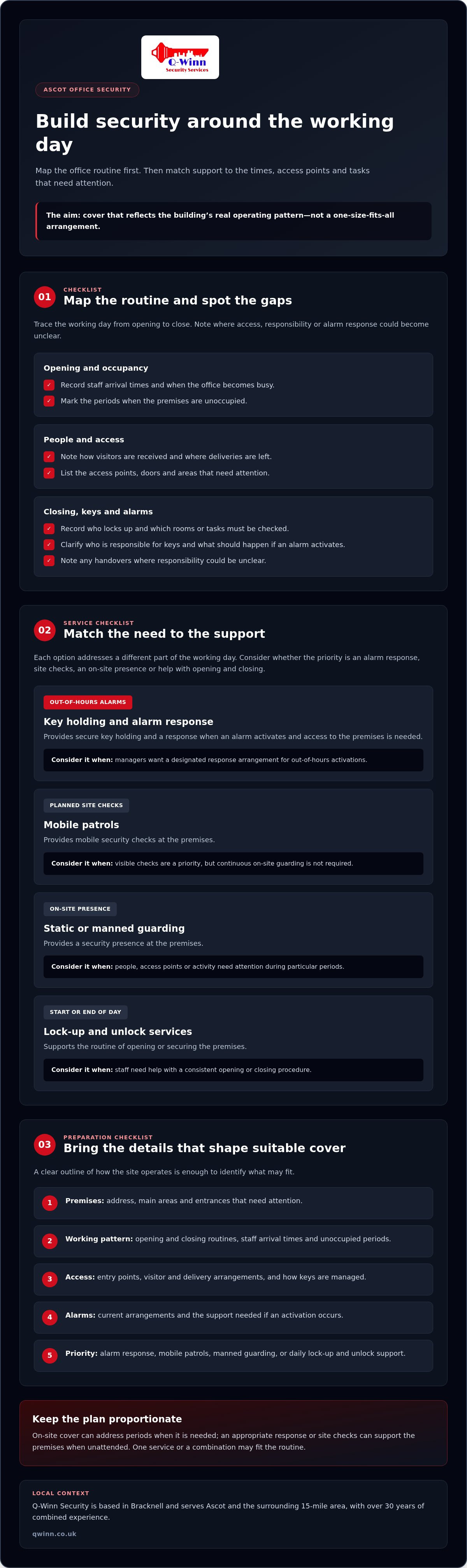
Map the working day from opening to close. Record staff arrival times, how visitors are received, where deliveries are left, who locks up, and when the building is unoccupied. List the doors, rooms or closing tasks that need checking, as well as any handovers where responsibility could be unclear. This makes it easier to distinguish between visible security while people are present and support after the office is empty.
Physical protection can include people, locks, barriers and other measures, as outlined in this Physical Security Overview. For an office, consider how security support fits the routine: key holding and alarm response address alarm activations and secure key access, while mobile patrols and manned guarding provide different forms of on-site support.
- Mark when staff, visitors and deliveries are expected.
- Record the closing routine and the periods when the office is empty.
- Note alarm arrangements, key responsibilities and any areas needing attention.
A proportionate security plan follows the building’s operating pattern: on-site cover when it is needed, and an appropriate response or site checks when it is unattended. That is the practical starting point for Ascot office security solutions.
How to match office security services to your Ascot site
Each service addresses a different part of the working day. The right fit depends on when people are on site, how visitors enter and what support is needed once the office is empty. Use this comparison to identify the role each service could play.
| Service | Practical role | May suit a site where |
|---|---|---|
| Key holding and alarm response | Provides secure key holding and a response when an alarm activates and access to the premises is needed. | Managers want a designated response arrangement for out-of-hours activations. |
| Mobile patrols | Provides mobile security checks at the premises. | Visible checks are a priority, but continuous on-site guarding isn’t required. |
| Static or manned guarding | Provides an on-site security presence. | People, access points or activity need attention during particular periods. |
| Lock-up and unlock services | Supports the routine of opening or securing the premises. | Staff need help with a consistent start-of-day or closing procedure. |
Which security service fits your office’s working pattern?
Consider the whole day, not only the hours when the office is empty. If your main concern is an alarm activating after staff leave, key holding and alarm response may be central to the plan. If access needs oversight while the premises are active, manned guarding may be more relevant. Mobile patrols provide site checks, while lock-up support can help keep opening or closing tasks consistent.
To define suitable cover, write down your opening hours, visitor and delivery arrangements, access points, closing routine and main priorities. Then compare those needs with the services in the table. This will help show whether one service or a combination best reflects the site’s routine. Good cover follows the working pattern, not a one-size-fits-all template.
For an overview of options that can be matched to your premises, explore Q-Winn’s security services.
Arrange office security in Ascot with a local response team
Start with how your premises operate, rather than a pre-set package. Explain when the office is occupied, how people access it and which tasks or risks concern you most. Q-Winn Security provides key holding and alarm response, mobile patrols, lock-up and unlock services, and static or manned guarding. These options can be considered in relation to your building’s routine and priorities.
Q-Winn Security is a family-run company based in Bracknell, serving Ascot and the surrounding 15-mile area. Its local, hands-on approach and over 30 years of combined experience provide a practical basis for discussing your office’s security requirements.
What to prepare before discussing office security
A few notes will help keep the conversation focused. Set out the premises’ location and daily pattern, then identify the risks or tasks you want support with. You do not need a finished security plan. A clear outline of how the site operates is enough to start identifying suitable cover.
- Outline the premises, including its address and the main areas or entrances that need attention.
- Explain opening and closing patterns, staff arrival times, and when the office is unoccupied.
- Describe access points, visitor or delivery arrangements, and how keys are managed.
- Summarise the alarm arrangements and what support you need if an activation occurs.
- Identify your priority: key holding and alarm response, mobile patrols, manned guarding, or daily lock-up and unlock support.
This sequence connects the security plan to real working conditions. An out-of-hours alarm concern points to a different requirement from regular help securing the office at closing time. Discussing the routine alongside the priority risks helps clarify whether one service or a combination is appropriate.
Ready to talk through your premises and priorities? Discuss office security with Q-Winn.
Take the next step towards a more secure office
Office routines change as teams, access arrangements and working hours evolve. Review your security plan when those patterns shift, so the cover continues to reflect how the premises are used. The right Ascot office security solutions should provide a clear plan for daily activity and for times when the building is unattended.
Q-Winn Security is a family-run company based in Bracknell, with SIA-licensed officers and 24/7 rapid response. Its services include key holding and alarm response, mobile patrols, static or manned guarding, and lock-up and unlock services. Discuss your priorities with the local team to consider practical cover for your office.
Ready to take a practical next step? Discuss office security for your Ascot premises and start shaping cover around your site’s needs.
Frequently Asked Questions
How much do office security solutions in Ascot cost?
Costs depend on the premises, the hours that need cover and whether you need one service or a combination. Key holding and alarm response has a retainer for secure key storage and response availability, with additional charges for alarm activations or emergency call-outs. An office needing this service has different requirements from one needing regular patrols or a staffed presence. Share your building and working pattern with Q-Winn to discuss suitable cover and fees.
What does an SIA-licensed security officer do?
An SIA-licensed security officer holds a licence from the Security Industry Authority for relevant licensable security activities. The licence relates to the security duties they undertake, rather than acting as a general qualification for every task on site. For an office manager, it helps clarify that an officer holds a licence relevant to their security role.
Can office security cover evenings and weekends?
Yes. Q-Winn provides 24/7 rapid response and key holding and alarm response for out-of-hours alarm activations. This is different from a scheduled mobile patrol, which involves planned site checks, or lock-up support, which follows agreed opening or closing routines. When discussing evening or weekend cover, explain when the building is empty and what support would help your team manage the premises.
How often should an office security plan be reviewed?
Review the plan when office hours, occupancy, access arrangements or use change, and after a security incident. For example, a new late-working pattern may affect who can access the building and how closing instructions are followed. Keep contact details, key information and site instructions current so the agreed arrangements continue to reflect how the office operates.
Frequently Asked Questions
Map the working day from opening to close. Record staff arrival times, how visitors are received, where deliveries are left, who locks up, and when the building is unoccupied. List the doors, rooms or closing tasks that need checking, as well as any handovers where responsibility could be unclear. This makes it easier to distinguish between visible security while people are present and support after the office is empty. Physical protection can include people, locks, barriers and other measures, as outlined in this Physical Security Overview. For an office, consider how security support fits the routine: key holding and alarm response address alarm activations and secure key access, while mobile patrols and manned guarding provide different forms of on-site support. A proportionate security plan follows the building’s operating pattern: on-site cover when it is needed, and an appropriate response or site checks when it is unattended. That is the practical starting point for Ascot office security solutions. Each service addresses a different part of the working day. The right fit depends on when people are on site, how visitors enter and what support is needed once the office is empty. Use this comparison to identify the role each service could play.
Consider the whole day, not only the hours when the office is empty. If your main concern is an alarm activating after staff leave, key holding and alarm response may be central to the plan. If access needs oversight while the premises are active, manned guarding may be more relevant. Mobile patrols provide site checks, while lock-up support can help keep opening or closing tasks consistent. To define suitable cover, write down your opening hours, visitor and delivery arrangements, access points, closing routine and main priorities. Then compare those needs with the services in the table. This will help show whether one service or a combination best reflects the site’s routine. Good cover follows the working pattern, not a one-size-fits-all template. For an overview of options that can be matched to your premises, explore Q-Winn’s security services. Start with how your premises operate, rather than a pre-set package. Explain when the office is occupied, how people access it and which tasks or risks concern you most. Q-Winn Security provides key holding and alarm response, mobile patrols, lock-up and unlock services, and static or manned guarding. These options can be considered in relation to your building’s routine and priorities. Q-Winn Security is a family-run company based in Bracknell, serving Ascot and the surrounding 15-mile area. Its local, hands-on approach and over 30 years of combined experience provide a practical basis for discussing your office’s security requirements.
Costs depend on the premises, the hours that need cover and whether you need one service or a combination. Key holding and alarm response has a retainer for secure key storage and response availability, with additional charges for alarm activations or emergency call-outs. An office needing this service has different requirements from one needing regular patrols or a staffed presence. Share your building and working pattern with Q-Winn to discuss suitable cover and fees.
An SIA-licensed security officer holds a licence from the Security Industry Authority for relevant licensable security activities. The licence relates to the security duties they undertake, rather than acting as a general qualification for every task on site. For an office manager, it helps clarify that an officer holds a licence relevant to their security role.
Yes. Q-Winn provides 24/7 rapid response and key holding and alarm response for out-of-hours alarm activations. This is different from a scheduled mobile patrol, which involves planned site checks, or lock-up support, which follows agreed opening or closing routines. When discussing evening or weekend cover, explain when the building is empty and what support would help your team manage the premises.
Review the plan when office hours, occupancy, access arrangements or use change, and after a security incident. For example, a new late-working pattern may affect who can access the building and how closing instructions are followed. Keep contact details, key information and site instructions current so the agreed arrangements continue to reflect how the office operates.