
Commercial key holding for warehouses and units in Wokingham
A warehouse’s security risk doesn’t end when the shutters come down. Q-Winn Security provides commercial key holding in Bracknell and the surrounding areas, holding your keys and responding when an alarm is activated so employees do not have to travel to the site. Industrial and warehouse units are found around Molly Millars Lane, Molly Millars Business Park and Anglo Industrial Estate.
It makes sense to want clear answers about who can access your premises, what happens after an alarm and whether the service suits your unit. This guide explains how key holding works for commercial sites, what to consider when choosing a provider and how the service fits local business locations. It also covers when patrols, lock-up and unlock services, or manned guarding may complement key holding, helping you identify the right approach for your premises.
Key Takeaways
- Learn how to assess SIA licensing and NSI or SSAIB accreditation as separate considerations when reviewing a key holding service.
- Compare outsourced key holding with employee or in-house cover by considering access, alarm response and the demands on your own staff.
- Identify the insurance and legal responsibilities to review for commercial premises, including how they relate to your security arrangements.
- See how key holding and alarm response can support warehouse and unit security in Wokingham, and when additional services may be relevant.
Are Wokingham key holding providers SIA licensed and NSI or SSAIB accredited?
SIA licensing and NSI or SSAIB accreditation are different checks. SIA licensing applies to individuals carrying out licensable security work, while NSI and SSAIB accredit organisations against recognised standards. Accreditation does not replace checking the duties performed by the person attending your premises.
For a warehouse near Molly Millars Business Park, focus on the actual response arrangements, not just a logo or headline claim. Ask the provider to explain what attending officers do and how those duties relate to SIA licensing. Collecting keys or attending an alarm can involve different responsibilities from guarding a site or controlling access. The role matters.
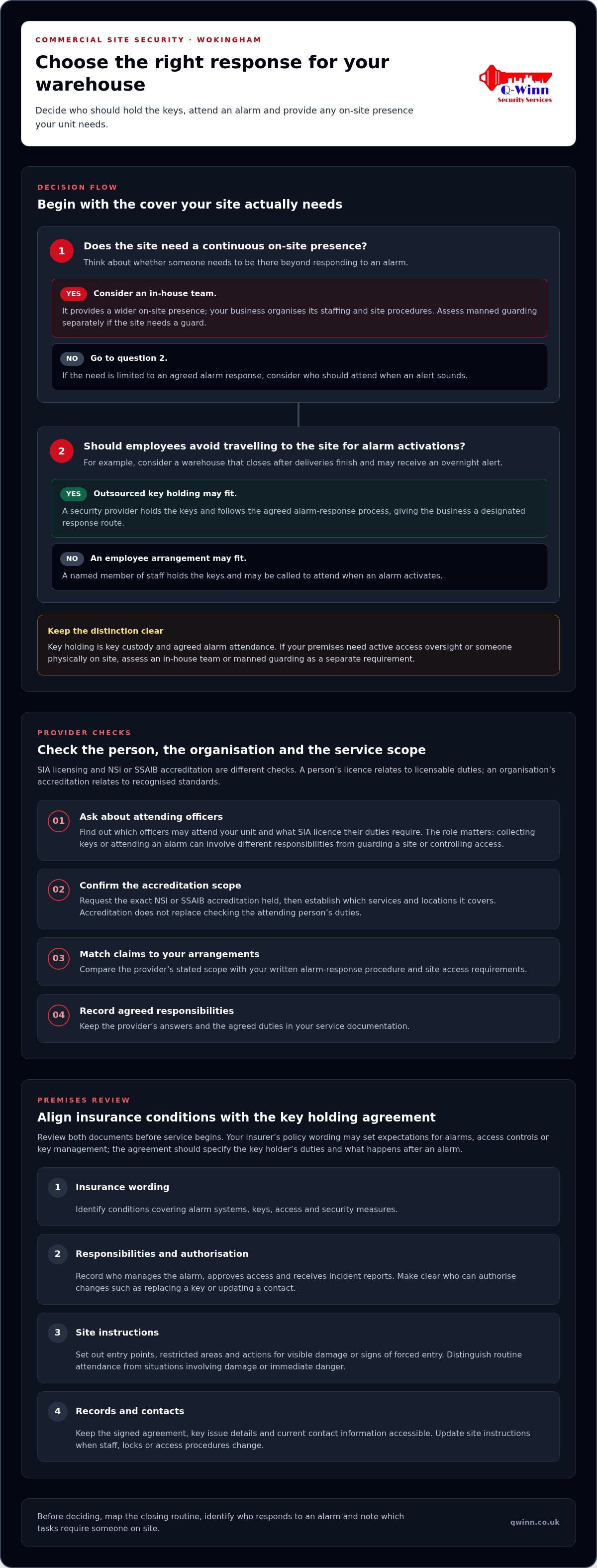
Check the provider’s claims in a practical order:
- Ask which officers may attend your Wokingham unit and what SIA licence their duties require.
- Request the exact NSI or SSAIB accreditation held, and establish which services and locations it covers.
- Compare the stated scope with your written alarm-response procedure and site access requirements.
- Record the provider’s answers and the agreed responsibilities in your service documentation.
These checks distinguish an individual officer’s licence from an organisation’s accreditation. They also help you assess whether the provider’s credentials match the service you need, rather than a different security activity.
When considering commercial key holding in Wokingham, ask clear questions about licensing and accreditation before deciding. A provider should explain who attends an alarm and what action they are authorised to take. If your unit needs a guard on site rather than key custody and alarm attendance, assess that requirement separately.
How does commercial key holding compare with using an employee or in-house security team?
For a Wokingham warehouse, the key difference is who responds when an alarm activates. With an employee arrangement, a named member of staff holds the keys and may be called to attend. Outsourced key holding assigns key custody and the agreed alarm response to a security provider. An in-house team provides a wider on-site presence, but your business must organise its staffing and site procedures.
Consider a unit on Molly Millars Lane that closes after deliveries finish. If an alarm sounds overnight, an employee may have to leave home and travel to the premises. Key holding provides a designated response route, while a permanent in-house team can also maintain a physical presence. Choose based on whether you need alarm attendance, ongoing guarding, or both.
Compare each arrangement with the work your site actually needs:
- Key access: Decide who holds keys, controls access and records any entry.
- Alarm procedure: Set out who receives the alert, attends and follows the agreed escalation steps.
- Staff impact: Consider the disruption when employees are repeatedly called away from normal duties.
- On-site cover: Choose an in-house team when continuous presence is central to site operations.
Keep the decision practical. Map your closing routine, identify who responds to an alarm, then note which tasks require someone on site. A business needing attendance after an alert may choose outsourced key holding; a site requiring active access oversight may need an in-house team or manned guarding. Record responsibilities so staff know whom to call and what happens next.
What insurance and legal requirements apply to commercial key holding in the UK?
For a commercial unit, distinguish your insurance conditions from the written security agreement. Your insurer’s policy wording may set expectations for alarms, access controls or key management. The agreement with a key holder should specify who keeps the keys, who may use them and what happens after an alarm. Compare both documents before service begins to avoid conflicting instructions.
For example, a warehouse lease may assign responsibility for securing doors, while the insurance policy sets conditions for protecting stock. The key holding agreement can describe the authorised response, entry arrangements and reporting process. Keep the current contact list and site instructions together, and update them when staff, locks or access procedures change.
Review these points for each Wokingham premises:
- Insurance wording: Identify conditions covering alarm systems, keys, access and security measures.
- Responsibility: Record who manages the alarm, approves access and receives incident reports.
- Site instructions: Explain entry points, restricted areas and actions for visible damage or signs of forced entry.
- Records: Keep the signed agreement, key issue details and updated contact information in an accessible place.
These steps help clarify how your insurer’s conditions fit with the provider’s agreed duties. If an alarm response requires entry, instructions should distinguish routine attendance from situations involving damage or immediate danger. Staff should know who can authorise changes, such as replacing a key or updating a contact. Clear records also help you explain the arrangement to a broker, landlord or site manager.
To discuss how key custody and alarm procedures can be set out for your premises, talk through your security requirements.
Q-Winn Security: Key Holding & Alarm Response
Q-Winn Security provides Key Holding & Alarm Response for businesses that need an agreed response plan for their commercial premises. It can suit a warehouse or unit where employees should not be responsible for attending every alarm activation. The service provides a defined process for key access and alarm attendance.
Match the arrangements to your operating routine. Lock-Up & Unlock Services can support scheduled opening and closing, while Mobile Patrol or Static / Manned Guarding may suit sites needing an additional security presence. The right combination depends on whether your priority is alarm attendance, regular locking procedures or an on-site guard.
Discuss your premises, access arrangements and response requirements with Q-Winn Security to plan a practical approach for your Wokingham business. Contact Q-Winn Security to talk through your requirements.
Set a clear security plan for your premises
Turn your Wokingham site’s daily routine into a practical security plan. Consider how staff leave the building, who needs access and what information an attending responder needs. A warehouse with separate office and loading areas may require different instructions from a single commercial unit. Clear, site-specific arrangements make responsibilities easier to understand and help you assess whether your current approach fits.
For commercial key holding in Wokingham, focus on your premises’ specific needs, not a one-size-fits-all checklist. Q-Winn Security can discuss your requirements and how key holding fits your site’s security arrangements.
Contact Q-Winn Security to discuss key holding and take a considered next step towards a plan that suits your business.
Frequently Asked Questions
What commercial key holding services are available in Wokingham?
Businesses in Wokingham can arrange key holding and alarm response, alongside options such as mobile patrols, lock-up and unlock services, and static or manned guarding. The right arrangement depends on your site routine. A warehouse needing alarm attendance, for example, has different requirements from a unit that also needs scheduled opening and closing.
Which key holding companies serve businesses in Wokingham and nearby areas?
Q-Winn Security serves Wokingham and nearby towns within its local service area from Bracknell, including Ascot and Crowthorne. If your business has premises in more than one town, consider how each site’s access instructions, key custody and alarm contacts will be organised. Clear arrangements help keep responsibilities consistent across locations.
What is included in a commercial key holding and alarm response service?
A commercial arrangement can include secure key storage and a trained response to alarm activations. Q-Winn Security describes its service as covering key holding and alarm response. For a unit with separate office and warehouse entrances, provide clear access instructions and explain which areas are restricted. Keep alarm contact details and site information current as staff or procedures change.
How quickly do key holders respond to alarm activations in Wokingham?
Q-Winn Security describes its response as 24/7 rapid response with fast on-site attendance. No fixed minute figure should be assumed. For a warehouse alarm, give the response team accurate directions, access details and escalation contacts. Clear information helps the attending key holder understand the site and follow the agreed procedure, whether the alarm signals a fault or a possible security incident.
How do businesses arrange commercial key holding and transfer keys securely?
Start by agreeing which premises are covered, who the authorised contacts are and what the alarm instructions say. Document who may access the unit, how keys are identified and how key custody is recorded. Hand over keys directly through an agreed process, not by leaving them unattended. Confirm the alarm details and site instructions are accurate, and update them whenever locks, access arrangements or nominated contacts change.
Frequently Asked Questions
Businesses in Wokingham can arrange key holding and alarm response, alongside options such as mobile patrols, lock-up and unlock services, and static or manned guarding. The right arrangement depends on your site routine. A warehouse needing alarm attendance, for example, has different requirements from a unit that also needs scheduled opening and closing.
Q-Winn Security serves Wokingham and nearby towns within its local service area from Bracknell, including Ascot and Crowthorne. If your business has premises in more than one town, consider how each site’s access instructions, key custody and alarm contacts will be organised. Clear arrangements help keep responsibilities consistent across locations.
A commercial arrangement can include secure key storage and a trained response to alarm activations. Q-Winn Security describes its service as covering key holding and alarm response. For a unit with separate office and warehouse entrances, provide clear access instructions and explain which areas are restricted. Keep alarm contact details and site information current as staff or procedures change.
Q-Winn Security describes its response as 24/7 rapid response with fast on-site attendance. No fixed minute figure should be assumed. For a warehouse alarm, give the response team accurate directions, access details and escalation contacts. Clear information helps the attending key holder understand the site and follow the agreed procedure, whether the alarm signals a fault or a possible security incident.
Start by agreeing which premises are covered, who the authorised contacts are and what the alarm instructions say. Document who may access the unit, how keys are identified and how key custody is recorded. Hand over keys directly through an agreed process, not by leaving them unattended. Confirm the alarm details and site instructions are accurate, and update them whenever locks, access arrangements or nominated contacts change.